
If you have PCOS, tracking ovulation can feel like solving a puzzle with missing pieces. Your cycles may be irregular. Your hormones don’t always follow the “textbook” pattern. And popular tracking apps often assume a 28-day cycle that just doesn’t apply to you.
Here’s the good news: ovulation tracking with PCOS is still possible. It just takes a slightly different approach, and often, a combination of methods rather than just one.
A quick note before we start: PCOS is now officially called PMOS, or Polyendocrine Metabolic Ovarian Syndrome. A global panel of experts renamed the condition to better reflect its hormonal and metabolic nature, not just its effect on the ovaries. You’ll still see “PCOS” used everywhere, including in this article, since the term is familiar and still widely used in daily life and medical records.
Why Ovulation Tracking Is Harder With PCOS
PCOS disrupts the normal hormonal signals that trigger ovulation. This makes predicting your fertile window more complicated than it is for someone with regular 28-day cycles.
Here’s what typically gets in the way:
- Irregular or absent periods make it hard to know when to even start tracking.
- Elevated LH (luteinizing hormone) can stay high throughout the cycle, not just before ovulation.
- Multiple false surges may show up on ovulation predictor kits.
- Anovulatory cycles (cycles without ovulation) happen more often.
This doesn’t mean tracking is pointless. It means you need tools that look at more than one signal at a time.
Method 1: Basal Body Temperature (BBT) Charting
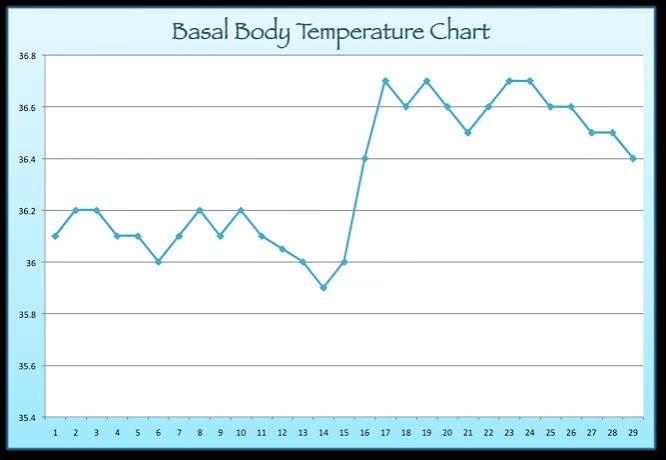
Basal body temperature is your body’s temperature at complete rest, first thing in the morning. It rises slightly after ovulation due to a jump in progesterone.
How to Do It
- Take your temperature every morning before getting out of bed.
- Use a basal thermometer for accurate, small changes.
- Record it at the same time each day, ideally within a 30-minute window.
- Plot it on a chart or app to see the pattern over time.
A sustained rise of about 0.5 to 1 degree Fahrenheit that lasts several days usually confirms ovulation already happened.
Why It Helps With PCOS
BBT charting doesn’t rely on LH levels, so it avoids the false-positive problem common with ovulation predictor kits. It confirms ovulation after the fact, which is still valuable for understanding your pattern over several months.
The downside is that BBT tells you ovulation happened, not that it’s about to happen. It works best combined with another method for real-time prediction.
Method 2: Cervical Mucus Monitoring
Your cervical mucus changes throughout your cycle in response to estrogen. Tracking these changes can help you spot your fertile window as it approaches, not just after it’s gone.
What to Look For
- Dry or minimal mucus right after your period ends.
- Sticky or tacky mucus as estrogen starts rising.
- Creamy, white mucus in the days building up to ovulation.
- Clear, stretchy, egg-white-like mucus near peak fertility.
This egg-white stage is your body’s most fertile sign. It usually appears one to two days before ovulation.
Tips for Women With PCOS
Women with PCOS sometimes experience mucus patterns that are less predictable or that show fertile-quality mucus without ovulation actually occurring. Because of this, cervical mucus is best used alongside BBT charting or ultrasound monitoring, not alone.
Method 3: Ovulation Predictor Kits (With Caution)
Standard ovulation predictor kits (OPKs) detect a surge in LH, which normally happens 24 to 36 hours before ovulation. The problem for PCOS is that baseline LH levels are often already elevated, which can trigger repeated false positives.
How to Use OPKs More Accurately With PCOS
- Test at the same time every day, ideally in the afternoon or evening.
- Track your results over a few months to identify your personal baseline.
- Look for a clear spike above your usual baseline, not just any positive line.
- Combine results with BBT or mucus tracking to confirm a real surge.
- Consider digital OPKs, which sometimes read subtle changes more clearly than test strips.
If you consistently get positive results for many days in a row, this may reflect a persistently elevated LH level rather than an actual ovulation surge. This is common in PCOS and worth mentioning to your doctor.
Method 4: Ultrasound Monitoring
For a more precise picture, some doctors use transvaginal ultrasounds to track follicle growth directly. This is often used when trying to conceive, especially alongside fertility medications like letrozole or clomiphene.
Ultrasounds can show:
- The size and number of developing follicles.
- Whether a dominant follicle is maturing.
- Signs that ovulation has occurred, based on follicle collapse.
This method is more accurate than at-home tools, but it requires clinic visits and is usually reserved for active fertility treatment cycles rather than everyday tracking.
Method 5: Blood Progesterone Testing
A blood test measuring progesterone levels, usually done about a week after suspected ovulation, can confirm whether ovulation actually happened. Progesterone rises significantly after an egg is released.
This test is typically ordered by a doctor, often alongside other fertility monitoring. It’s especially useful if your cycles are irregular enough that timing home tests feels like guesswork.
Combining Methods for Better Accuracy
No single method is perfect for PCOS on its own. Combining two or three approaches gives a clearer, more reliable picture.
A practical combination many women use:
- BBT charting every morning to confirm ovulation after it happens.
- Cervical mucus tracking to catch the approaching fertile window.
- OPKs, interpreted carefully, as a secondary confirmation signal.
Over a few months, this combination helps you understand your personal pattern, even if your cycles vary in length.
Tracking Cycle Length, Even When Irregular
Even without a predictable ovulation date, tracking cycle length still gives useful information. Note the first day of each period, and count the days until the next one starts.
Over several months, you may notice:
- A range your cycles tend to fall within, even if inconsistent.
- Seasonal or lifestyle patterns affecting cycle length.
- Whether cycles are shortening or lengthening over time.
This data is genuinely useful to bring to a doctor’s appointment. It helps them understand your baseline before recommending next steps.
Lifestyle Factors That Affect Your Tracking Signals
Your daily habits can shift your ovulation signals, sometimes in confusing ways. Knowing this helps you read your data more accurately.
Sleep and Stress
Poor sleep and high stress raise cortisol levels. This can delay ovulation or throw off your BBT readings entirely. A late night out or a stressful week can show up as a temperature blip that has nothing to do with your cycle.
Illness and Alcohol
A cold, fever, or even a late-night glass of wine can raise your basal body temperature the next morning. Note these events on your chart so you don’t mistake them for ovulation.
Travel and Time Zone Changes
Traveling across time zones can shift when you take your temperature, which affects accuracy. Try to keep your testing time as consistent as possible, even while traveling.
Weight Changes
Both significant weight loss and weight gain can affect hormone levels and, in turn, ovulation patterns. This is particularly relevant for insulin-resistant PCOS, where even modest weight changes can shift cycle regularity.
Medications and Supplements
Metformin, inositol, and hormonal birth control can all influence your cycle and your tracking signals. If you start or stop a medication, expect a few months of adjustment before your patterns stabilize again.
Keeping a simple log alongside your tracking data, noting sleep, stress, illness, or medication changes, makes it much easier to separate real ovulation signals from noise.
When Tracking Alone Isn’t Enough
If you’ve been tracking for several months and still can’t pinpoint ovulation, or you’re not seeing consistent signs of ovulation at all, it’s worth talking to a doctor or fertility specialist.
This is especially important if:
- You’re trying to conceive and haven’t had success after several months.
- Your periods are absent or extremely irregular.
- You suspect anovulatory cycles are happening regularly.
- You want to explore medication options like letrozole to support ovulation.
Doctors can combine bloodwork, ultrasounds, and your tracking history to build a much clearer picture than any app or kit alone.
A Few Realistic Expectations
Tracking ovulation with PCOS takes patience. Some months your signs may be clear. Other months, they may be confusing or absent altogether. This is common, and it doesn’t mean something is wrong with your effort.
Give yourself several cycles before expecting a clear pattern to emerge. Small inconsistencies are normal, not a sign of failure.
Final Thoughts
Tracking ovulation with PCOS (now also known as PMOS) is rarely a one-tool job. BBT charting, cervical mucus tracking, careful OPK use, and occasional medical testing all add pieces to the puzzle. Used together, and given a few months of consistent effort, they can give you a genuinely useful picture of your cycle, even when it doesn’t follow a textbook pattern.
If you’re actively trying to conceive, pairing your own tracking with support from a doctor gives you the most complete and reliable path forward.
This content is for informational purposes only and does not constitute medical advice. Always consult a qualified healthcare provider for diagnosis and treatment.
FAQs
Can you track ovulation with PCOS using regular apps?
Standard cycle apps often assume a 28-day cycle, which doesn’t fit most PCOS patterns. They can still help with logging symptoms, but they shouldn’t be your only tracking tool.
Why do ovulation predictor kits give false positives with PCOS?
PCOS often causes chronically elevated LH levels, not just a short pre-ovulation surge. This can trigger repeated positive results that don’t reflect actual ovulation.
What is the most reliable way to confirm ovulation with PCOS?
A blood progesterone test, done about a week after suspected ovulation, is one of the most reliable confirmations. BBT charting is a helpful at-home alternative.
How long should I track before expecting a clear pattern?
Most women need at least 2 to 3 months of consistent tracking before a pattern starts to emerge, especially with irregular PCOS cycles.
Is PMOS the same condition as PCOS?
Yes. PMOS, or Polyendocrine Metabolic Ovarian Syndrome, is the new name for PCOS following a global expert consensus. The diagnosis and condition itself have not changed.