Fertility can feel like a mystery, even though it’s happening inside your body every month.
Maybe you’re just curious. Maybe you’re starting to think about having kids someday. Either way, understanding the basics helps everything else make sense.
This post breaks down female fertility in plain language. No complicated jargon, no overwhelming detail. Just a clear explanation of how it actually works.
This post is part of our complete female fertility guide, which covers everything from ovulation to testing to natural ways to boost your chances of conceiving.
What Does “Female Fertility” Actually Mean?
Female fertility is simply your body’s ability to conceive and carry a pregnancy. It’s not one single thing. It’s several systems working together.
Your ovaries need to release a healthy egg. Your hormones need to stay balanced enough to support that release. Your uterus needs to be ready to support a pregnancy if fertilization happens.
When people say someone is “fertile,” they usually mean all of these parts are working together smoothly. When one part is off, it can affect the whole process.
Fertility also isn’t a fixed number that stays the same forever. It changes with age. It shifts with your health. Some months, your body is more fertile than others, even within a completely normal cycle.
Understanding these moving parts helps take some of the mystery out of it. It also helps you know what’s normal and what might be worth a conversation with a doctor.
The Main Players: Your Reproductive Organs
Before diving into hormones and cycles, it helps to know what’s actually involved.
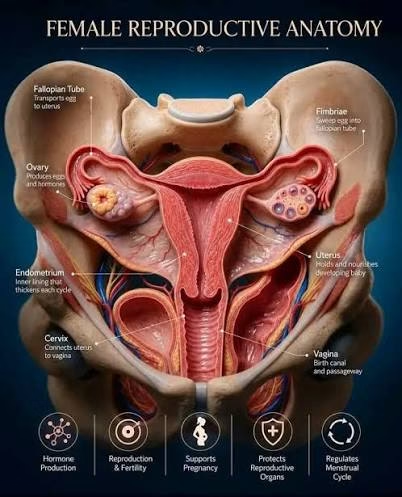
- Ovaries — store your eggs and release one each month during ovulation
- Fallopian tubes — carry the egg from the ovary toward the uterus
- Uterus — where a fertilized egg implants and a pregnancy develops
- Cervix — connects the uterus to the vagina and produces fertile mucus
These parts don’t work in isolation. They’re coordinated by hormones, which act like messengers telling each part what to do and when.
The Hormones Behind Fertility, Explained Simply
Hormones sound complicated, but the basic idea is simple. They’re chemical messengers that tell your body what to do next.
FSH: The Starter
FSH (follicle-stimulating hormone) kicks off each cycle. It tells your ovaries to start developing an egg for that month.
LH: The Trigger
LH (luteinizing hormone) builds up and then surges. That surge is what actually triggers the egg’s release. This is the hormone ovulation tests detect.
Estrogen: The Builder
Estrogen rises as the egg develops. It thickens your uterine lining and creates the fertile mucus that helps sperm travel more easily.
Progesterone: The Maintainer
Progesterone rises after ovulation. It keeps the uterine lining stable, ready to support a pregnancy if the egg gets fertilized.
AMH: The Supply Gauge
AMH (anti-Müllerian hormone) reflects how many eggs you have left. Doctors use it to estimate your ovarian reserve.
These hormones work as a team. When they’re balanced, ovulation tends to happen on a predictable schedule. When one is out of sync, it can throw off the whole cycle.
How the Menstrual Cycle Fits Into Fertility
Your period is often the most visible part of your cycle. But fertility depends on the whole cycle, not just that one week.
A typical cycle runs about 28 days, though anywhere from 21 to 35 days is considered normal. It breaks down into four phases:
- Menstrual phase — your period, when the old uterine lining sheds
- Follicular phase — your body develops a new egg for release
- Ovulation — the egg is released from the ovary
- Luteal phase — your body prepares for possible pregnancy
Ovulation is the phase that matters most for conception. Without it, pregnancy can’t happen naturally that month.
If your cycles are very irregular, it often means ovulation isn’t happening consistently. Tracking your cycle length over a few months gives you real insight into your own pattern.
What Happens During Ovulation?
Ovulation is the moment your ovary releases a mature egg. It’s the single most important event in your fertility cycle.
Here’s a simplified version of what happens:
- Rising FSH tells a group of follicles to start developing
- One follicle usually becomes dominant and matures fastest
- Estrogen rises as that follicle grows
- A surge in LH triggers the mature egg’s release
- The egg travels into the fallopian tube, ready for possible fertilization
This entire process usually happens once per cycle. Most women ovulate around day 14 of a 28-day cycle, though this varies based on your personal cycle length.
Once released, the egg only survives for about 12 to 24 hours. That’s a short window, which is exactly why timing matters so much for conception.
Understanding Your Fertile Window
Your fertile window is the stretch of days each cycle when pregnancy is actually possible.
Here’s why it’s longer than just the day of ovulation:
- The egg survives about 12 to 24 hours after release
- Sperm can survive inside the body for up to five days
- This overlap creates a window of about six fertile days total
The most fertile days are usually the two to three days right before ovulation, plus the day of ovulation itself. Sperm that arrive early can simply wait for the egg to be released.
Because cycle length varies, calendar counting alone isn’t always reliable. Tracking signs like cervical mucus, basal body temperature, or ovulation tests gives a clearer picture.
Fertilization: What Happens If Sperm Meets Egg
If sperm reaches the egg during the fertile window, fertilization can occur inside the fallopian tube.
The fertilized egg then begins dividing as it travels toward the uterus. This journey takes several days.
Once it reaches the uterus, it needs to implant into the uterine lining, which progesterone has already prepared. Implantation usually happens six to ten days after ovulation.
Not every fertilized egg successfully implants. This is a normal, common part of reproduction, and it’s one reason conception can take more than one cycle, even when everything is working as expected.
This is also why trying for a few months without success isn’t automatically a red flag. Biology involves a fair amount of natural trial and error, even in healthy, fertile bodies.
What Affects Female Fertility Over Time
Fertility isn’t static. Several factors influence it, some within your control and some not.
- Age — egg quantity and quality both decline gradually over time
- Weight — being significantly underweight or overweight can disrupt ovulation
- Hormonal conditions — like PCOS, which can prevent regular ovulation
- Lifestyle habits — including sleep, stress, smoking, and alcohol use
- Underlying health conditions — like thyroid disorders or endometriosis
None of these factors work in isolation, and having one doesn’t automatically mean trouble conceiving. They simply shift the odds, sometimes in small ways and sometimes in bigger ones.
Understanding which factors apply to you is more useful than worrying about all of them at once.
How Age Affects Female Fertility
Age deserves its own mention, since it’s one of the most significant factors in fertility.
You’re born with all the eggs you’ll ever have. That number declines steadily over your lifetime, and egg quality declines too.
A general pattern looks like this:
- Fertility is generally highest in your 20s
- It starts a gradual decline in your early 30s
- The decline speeds up after age 35
- It drops more noticeably after 40
These are population averages, not guarantees for any one person. Some women conceive easily in their late 30s. Others face challenges earlier. Age shifts the odds, but it doesn’t decide your individual outcome.
Common Signs Your Cycle May Signal a Fertility Issue
Your monthly cycle often gives early clues if something is worth a closer look.
Signs worth paying attention to include:
- Very irregular or absent periods
- Extremely heavy or extremely light periods
- Severe menstrual pain that disrupts daily life
- No pregnancy after 12 months of trying, or 6 months if you’re over 35
- Signs of hormone imbalance, like excess acne or hair growth
One of these on its own isn’t necessarily alarming. A pattern of several together is worth discussing with a doctor, rather than waiting it out indefinitely.
A Few Fertility Myths Worth Clearing Up
Fertility comes with a lot of myths. A few are worth addressing here, since they can cause unnecessary worry.
“You can always tell when something’s wrong.” Many fertility-related conditions have no obvious symptoms for years. Regular checkups matter, even when you feel fine.
“Fertility only becomes an issue after 40.” The decline actually starts earlier, gradually, in your early 30s for most women.
“An irregular cycle always means infertility.” Irregular cycles can make timing harder, but they don’t automatically mean you can’t conceive.
“Stress alone causes infertility.” Chronic stress can affect hormone balance, but it’s rarely the sole cause of fertility struggles.
Clearing up myths like these helps you focus on what’s actually useful: understanding your body, tracking real patterns, and talking to a doctor when something feels off.
Why Understanding This Matters
You don’t need a medical degree to understand your own fertility. But knowing the basics changes how you experience your body.
It replaces vague worry with real information. And real information is almost always easier to act on than guesswork.
It helps you recognize what’s normal and what isn’t. It helps conversations with your doctor feel less confusing. And if you’re planning to conceive, it helps you time things more effectively, instead of guessing.
Fertility isn’t something to fear or overanalyze. It’s simply a system, like any other in your body, that works best when you understand how the pieces fit together.
Where to Go From Here
Understanding how female fertility works is the foundation. From here, you might want to explore how to actively track ovulation, what to eat to support your cycle, or when it makes sense to see a specialist.
Our complete female fertility guide covers all of it in one place, including diet, testing, lifestyle factors, and natural ways to support conception.
Final Thoughts
Female fertility comes down to a few coordinated systems: your ovaries, your hormones, and your uterus, all working together on a monthly rhythm.
Ovulation sits at the center of it. Understanding when it happens, and what affects it, gives you real insight into your own body.
You don’t need to memorize every hormone name or every biological step. Just knowing the big picture helps you feel more in control, whether you’re simply curious or actively planning for the future.
FAQs
What is female fertility in simple terms?
Female fertility is your body’s ability to release a healthy egg and support a pregnancy if that egg gets fertilized.
What is the most important hormone for fertility?
No single hormone works alone, but LH triggers ovulation, which is the key event needed for natural conception.
How many days am I fertile each cycle?
Most women have a fertile window of about six days, ending on the day of ovulation.
Does ovulation happen at the same time every month?
Not exactly. Ovulation timing can shift slightly from cycle to cycle, even in generally regular cycles.
Can I be fertile with an irregular cycle?
Yes, but irregular cycles often make ovulation less predictable, which can make timing conception harder.
Does age really affect fertility that much?
Yes. Egg quantity and quality both decline gradually with age, especially after your mid-30s.
What’s the difference between fertility and ovulation?
Ovulation is one event within your cycle. Fertility is the broader ability of your body to conceive and sustain a pregnancy.
Can I improve my fertility naturally?
Many lifestyle factors, like diet, weight, sleep, and stress, can support fertility, though they don’t guarantee results for everyone.
This content is for informational purposes only and does not replace medical advice. Always consult a qualified healthcare provider about your specific fertility concerns.